I thought Canada was cold. And then I moved to England

By Barry Rueger
Published: Globe and Mail
December 18, 2025
980 words

EDF Smart Meter

A few weeks ago, we began our Christmas season with the Advent Procession service at Great St. Mary’s in Cambridge. Like all older stone-built churches in Europe, St. Mary’s has no heating system. Despite our scarves and heavy winter coats we were shivering by the time that the choir and organist had finished, and even Rev. Clare Stephenson, who led the service, and offered us her blessing as we left, had the look of someone who was very ready for a warm fire and a glass of Christmas cheer.

The British are a proud people. They are justifiably proud of their history, still dwell on their memories of empire, can celebrate literary icons like Chaucer and Shakespeare, and more recently still have vestiges of waning pride in their rejection of Europe during Brexit. But more than all of that, the British find their greatest pride in being cold.

Before moving to Cambridge, where my wife Susan is studying for her Master of Philosophy in Musicology, I had of course heard the jokes about slippers and cardigans, and about the British obsession with not spending money on heat. What I now know is that these weren’t jokes – they were the very foundations of a national culture.

We’re renting one of the Charterhouse terraced cottages in the village of Grantchester, on the outskirts of Cambridge. It’s a lovely home, built around 1880, with a great landlord, and the 250-year-old Blue Ball Inn just two doors down. That pub turns out to be a very good thing because when our home is too cold to stay in, the pub always has a roaring blaze in the fireplace. The downside is that our bills for cask ale and pork pies are approaching what we pay for electricity.

We have a Smart Meter from EDF, our electricity company. Minute by minute a little light is either green (good), amber (caution), or red – you’re using too much power! The screen shows us exactly, to the penny, how much we’ve spent on energy as each day progresses. During the cold snap in November that daily number crossed £10. Our Canadian minds quickly translated £300 a month to $550 Canadian dollars!

What I’ve learned since arriving in Britain is that yes, everyone wears layers of clothing indoors, and that yes, likely only one room in the house is heated at any time. Old houses are drafty, and the heating systems are unlike anything I experienced in Canada. Our cottage has “storage heaters,” which take advantage of half-price overnight electricity rates (charging double the rate we paid in Vancouver) to heat large, heavy ceramic blocks inside of a radiator. In the morning when electricity prices jump (to triple Vancouver rates!) that stored heat is allowed to escape and heat the room. At least until around dinner time, when the stored heat has run out.

As I sit on the sofa, reading, with my feet curled up under me keep them warm, or while we snuggle under a duvet while watching the BBC, I’m reminded of our home in Canada. Homes there have big gas or oil-fired furnaces, double glazed windows, and (oh how I miss it) under-floor heating. I remember being able to walk from room to room and stay warm no matter where I went. I look back fondly on turning up a thermostat without a moment’s hesitation, making everything just a little bit warmer because, really, it costs so little.

Like a lot of Canadians, we’ve spent many evenings watching programs like The Crown and Downton Abbey. In both series the most memorable set pieces show people deep in discussion beside a roaring fireplace. What I now realize is that 10 feet away from the hearth people were likely shivering frigidly. Even the wealthy and powerful in Britain live half the year in the cold.

Because the heating systems in British homes are so spartan, almost every single room in the house – including the bathroom – has a small, plugged in, electric heater to “take the edge off” the cold. These inefficient little boxes do warm things up a bit, but are an expensive solution.

Although their homes and apartments may be cold, the British people are genuinely warm and helpful. When we’ve complained about being chilly, they’ve been quick to suggest solutions.

“Layer the floor; even newspapers under a rug stop the cold coming up.” “Eat something warm and calorie-dense before bed to keep core temperature steady.” “Cafés with poor ventilation tend to be warmest; linger.”

And my favourite: “A small pet is effectively a mobile heat source. Cats are the most efficient, but anything warm-blooded helps.”

Which is not to say that the British couldn’t also improve their insulation, and add weather-stripping to doors, and price their electricity a little bit more for comfort than profit.

Of course, when I look back fondly on our toasty, warm Canadian homes, I can’t help but think about how they were heated. In B.C. you might be able to use the power from hydro-electric dams, and in Ontario from nuclear power plants, but more likely your furnace still burns natural gas, or in Atlantic Canada, heating oil. We were warm all winter in our Nova Scotia farmhouse, but the oil heating is one small part of the global warming that led to this year’s Maritime drought.

The other morning, I came down for coffee and breakfast. I stepped into a freezing kitchen and found Susan warming her hands over the toaster. “Seriously,” she said, “I feel like Hans Christian Andersen’s ‘Little Match Girl’, scrabbling for whatever scrap of warmth I can find.”

I smiled at that image – until I took the time to read the story that I vaguely remembered from childhood. The Little Match Girl was found frozen to death.

What happens when the well runs dry? After months of drought, Nova Scotians are finding out

By Barry Rueger
Published: Globe and Mail
November 1, 2025
935 words

Dug Well

Barry Rueger is a writer currently based in the U.K.

A few weeks ago, our well ran dry. Our Western Head farmhouse, near Liverpool, N.S., is old. Approximately 46 per cent of Nova Scotia homes rely on wells for household water. Like many of them, we have a dug well – a stone-lined hole in the ground, maybe one-and-a-half metres across by seven or eight metres deep. That well normally holds 3,000 gallons of water, filled by the groundwater that flows up from deep in the Earth.

That groundwater has disappeared, and now our well is dry. Four hundred dollars bought us a 3,000-gallon tanker full of water to refill the well, but instead of stabilizing the water level, it’s disappearing quickly into the soil. We’re faced with a choice: Spend $20,000 for a new, deeper, drilled well, or close up our wonderful farmhouse and ask our tenants to find a new home – one with running water.

Canada’s severe drought is a sign of future climate conditions and calls for action, experts say

The larger question is what the Nova Scotia government is doing to assist homeowners with dry wells. They’ve been quick to suggest that you take shorter showers, or use waste water to refill your toilet tank, but when you have literally no running water that doesn’t help.

If you’re retired and living on a pension, or if you’re a single mother struggling to feed your children, you need a government that will pay for water delivery to your house, or even for part of the cost of drilling a new well. You need a government that understands that clean, running water is essential to life. It’s not a luxury.

Atlantic Canada has been in a drought for months now. According to Agriculture Canada most of Nova Scotia has received less than 40 per cent of normal precipitation during a recent three-month stretch. For the first time in many years the summer went by with no tropical storms, or indeed storms of any sort. Without rain the ground dries out, and then wells dry out too.

For much of rural Nova Scotia this is a disaster. There’s no count of the number of households without running water, but the number is large enough that drilling companies and water delivery services are working overtime.

As I write this I’m talking to drilling companies to see who could create a new well for us. In Nova Scotia anyone who can provide water is working seven days a week. Heather Jefferson, operations manager at DJ’s Well Drilling, up the road from us in Bridgewater, tells me, “We are drilling wells through the week and putting pumps in on the weekends. We are booking for the end of December or the New Year.”

Another major drilling company, after being profiled in the Halifax newspaper, has a voice-mail box that’s constantly full, and an e-mail address that just bounces back to the sender. Every drilling company is busy, as are water delivery services.

Life in Nova Scotia can sometimes be hard, but life without running water is an entirely different level of difficult. We were used to hauling five-gallon bottles of water for drinking and cooking from the Queens County water refill station, but that doesn’t get you a hot shower after a long day at work, or run your washing machine.

‘Forever chemicals’ in tap water leave these communities in a toxic limbo

The reality for rural Nova Scotians today is this: If you can afford to spend $20,000 – or more – you can drill a new well that likely will give you water. If you don’t have that money – and Nova Scotia has an aging population, and low incomes – you really have no options except to shower at the local municipal gym, and hope for rain.

Hiring a company for $20,000 to drill a new well may not even help you. Sometimes they drill a dry well and you still need to pay, or pay thousands of dollars more for fracking to break up the underground rock and let water seep in. If you’ve lived your life in a city or town with running water, let that sink in: In Nova Scotia you can pay $20,000 and still have no water.

Right now my wife and I are in Cambridge, in Britain, while she completes a degree at the university here. A dry well doesn’t affect our day to day lives, but it means we’re spending hours each day looking for a solution. After trying to find some way to provide running water for the three young construction workers renting from us, it feels like closing up the house is the only choice.

For most people this drought was a surprise. Our well has stayed full to the top for more than 100 years, and there was no reason to expect it to suddenly stop giving us water. Just two weeks before the tenants moved in, a cleaning crew scrubbed the house and never ran out of water. As of today we no longer have tenants, and we no longer have the monthly income that we are relying on to pay our rent in England.

This is not the fault of individual homeowners. What many in Nova Scotia (and in other drought-stricken places across Canada) believe is that droughts like this are tied to global warming and the dramatic shifts in weather patterns caused by climate change.

Unfortunately, because our governments refuse to stop the extraction and use of fossil fuels, climate change will continue, and this won’t be the last time wells in Nova Scotia run dry.

Why I added my name to the long ballot in Pierre Poilievre’s by-election

By Barry Rueger
Published: Globe and Mail
August 14, 2025
858 words

Barry Rueger is an author and is running as a candidate in the Battle River-Crowfoot by-election in Alberta.

In April of this year, I worked for Elections Canada. I was a service agent in the weeks leading up to the federal election, helping early voters to complete their ballots.

I have two distinct memories.

There was a young couple from Syria who brought in their Canadian citizenship certificates, barely two weeks old, and showed them to me proudly as they prepared to vote here for the first time. They took the process incredibly seriously, and had obviously done their homework.

Another group of voters that stood out were older, Canadian-born, didn’t know who the candidates were, and, in some cases, didn’t even know which riding they were voting in. These were people who voted for one party election after election, with no questions asked.

Such people are the reason why Conservative Party Leader Pierre Poilievre is now running in the riding of Battle River-Crowfoot, in Southern Alberta. On April 28, more than 82 per cent of the riding’s voting constituents (or 53,684 of 64,807 eligible ballots) elected Damien Kurek, the Conservative candidate. They voted for a local boy who was a “fifth-generation farmer” and who had been a worker in the oil-and-gas industry. It was the third time in a row they had elected him, but just a few days later, he indicated he would be willing to resign his seat. The reason? Mr. Poilievre had been defeated in his Ottawa-area riding of Carleton, and needed a presumably safe seat to return to Parliament.

Like that young immigrant couple, I care a lot about my vote. I take the time to look at candidates and parties, and try to choose the person who I think will represent me and the people who live in my town. I don’t just vote for a party; I vote for an individual.

If I were one of the 53,684 people in Battle River-Crowfoot who voted for Mr. Kurek, I would be angry right now. I would be wondering why someone who had received my vote in three elections would suddenly abandon his position as a member of Parliament for a job as a lobbyist. And I’d be wondering how a candidate who had just been defeated in his own riding in Ontario was supposed to understand my needs, and fill the role of a rural Alberta MP.

Mr. Kurek’s decision to step down is why I joined 200 other Canadians in registering with the Longest Ballot Committee. Our names will all be on the ballot with Mr. Poilievre, not because any of us expect to win, but because we’re saying that there is something very broken in Canadian politics.

I’m running in this by-election because I believe it’s time for Canada to find a new way of choosing the people that we send to Ottawa. I’m running because I’m one of the people who felt hopeful when Justin Trudeau promised a new and better electoral system, only to back out when he realized the old system worked better for him. I’m also running to make the point that the rules determining how MPs are selected, and how governments are formed, should be crafted and implemented by a non-partisan body of independent citizens, the genuine working people who are most affected by government actions – or inaction – and not the politicians themselves.

I’m the grandson of homesteaders who broke barren ground in Saskatchewan and lived in a sod hut. I was born in Calgary, and went to school there. My relatives are all Albertans; people who work on farms, or in oil and gas, who hunt and fish, and volunteer for the local fire department.

When I look at Mr. Poilievre, I see someone who has never worked a real job in his life – who has never got his hands dirty picking fruits or vegetables (like I have), or done factory work (like I have), or carried sheets of plywood across an icy construction site.

With Mr. Kurek, the voters in Battle River-Crowfoot had a candidate who truly represented their community: someone who had done the same sort of work as his constituents. Now, instead, they’re being handed a life-long professional politician.

Since his defeat in the Carleton riding, and his appearance on the Battle River-Crowfoot ballot, Mr. Poilievre has called the Longest Ballot Committee’s actions “a scam” and wants our form of protest to be banned. Some social-media pundits have posited that running for office should require a $1,000 deposit (which was rendered illegal by a Court of Queen’s Bench of Alberta ruling in 2017)

Since John A. Macdonald in 1867, every single one of Canada’s 24 prime ministers has been either a Conservative or a Liberal. When voters’ choices are limited to the two “natural” governing parties, it’s inevitable that politicians will grow lazy, or even corrupt, and will wind up offering no real choice to the electorate.

I am running in Battle River-Crowfoot because I agree with my fellow Longest Ballot nominees that our electoral system needs reform, and that those reforms will only come to pass as a result of pressure from ordinary Canadians. Other countries have managed this, and it’s time for Canada to do the same.

I want a home, not an investment

By Barry Rueger
Published: Globe and Mail
June 19, 2025
1055 words

After two years of living in France, it was time for my wife and me to come home. She went first, to Nova Scotia, to look at houses for sale. After a week Susan phoned me, excited, and said, “This is it!”

My inbox was soon filled with videos, property descriptions, and photos of a 140-year-old farmhouse at Western Head, just outside Liverpool.

It was an old, charming and quirky home, with grey cedar shingles, a bay window, and a septic tank that needed to be replaced. It has a barn where I eventually hope to add a writing studio, and it has enough land for a serious garden to grow our own fruit and vegetables.

Built sometime around 1880, it was old enough that we knew it would have hidden problems, and even before we made an offer we could see that the roof needed to be replaced. The money-guzzling oil-burning furnace would also need to go, replaced by heat pumps, or, if our budget allowed, geothermal heating.

In Nova Scotia terms, we’re outsiders. Because we’re coming from “away,” we probably paid more than a local person would have, but the house is perfect for us, with room for books and records, an office and a grand piano. We can look out the windows and see the Atlantic Ocean and the lobster boats, and we can hear the foghorn at the Western Head lighthouse down the road.

Despite all of the shortcomings, we knew we had found our home. And somehow we never once asked ourselves: “But is it a good investment?”

The newspapers are full of Prime Minister Mark Carney’s plans for helping Canadians, especially young Canadians, to buy homes. The stumbling block always seems to be a concern that if governments support building more homes, the resale prices of existing houses will go down – that homeowners will lose equity.

What Mr. Carney is missing is that for most ordinary people, a house, or even a rented apartment, isn’t an investment opportunity – it’s a home. Nearly everyone that I have known has moved into their home with every intention of living there permanently. They repaint the living room and hallway because they like the new colour, and they spend weeks and years building the flower gardens because they love to look at them. They add decks, bird feeders, and lights at Christmas.

They aren’t doing this because they’re aiming to add to potential resale value; they’re making an ordinary house into their home.

Because our farmhouse in Nova Scotia is our home, we don’t really care about its market value. We didn’t buy our farm house to resell it; we bought it to live there, to watch the birds at our feeder, the occasional deer or raccoon, and to watch the family of snow hares that nests under our deck change their coats from brown to white as winter approaches.

We bought that house, and love that house, because the Atlantic sunrises are beyond beautiful, and the stars at night are breathtaking, and because when storms arrive they are like nothing we’ve ever experienced.

And when we get home after a trip, or shopping, or work, we walk in the back door and say, “Oh, it’s so good to be home.”

My parents bought their first house in 1966 in Kelowna, B.C., on Morrison Avenue. That was my home for six years, from grade three to high school. In 1972 we moved into a newly built house a few blocks away on Charolais Road. I lived there, in a bedroom with orange shag carpeting, until I left for university. My mom stayed in that house until after my father died in 1994. She then moved into a sweet little bungalow on Ziprick Road that was her home until she died in 2021 during the pandemic.

Three houses over 55 years. That wasn’t about making investments; it was about making a home.

We moved to Nova Scotia for one reason: Susan’s son Haruki, his wife Sofia, and our three grandchildren lived in another old wooden farmhouse, about an hour down the road, just outside of Shelburne. We really wanted to be close to our grandchildren, but also wanted our separate lives, so the distance between us was just right. Susan cooked holiday dinners, and I built a swing-set and slide in the yard.

Early one morning, just a few months after we finally had all of our furniture, books and sheet music unpacked, we received a distressing phone call. Haruki and Sofia’s house had caught fire during the night, and by morning had burned to the ground. The family escaped with little more than their laptops and the clothes they were wearing. Nearby neighbours brought food and bags of used clothing, and kept the children out of harm’s way.

Susan and I drove the children home to our house in Liverpool, while Haruki and Sofia, likely still in shock, watched the last of the firefighting. While we cared for the kids, their parents took the time to come to terms with what happened, and to try to plan for the coming days.

Our Liverpool farmhouse was suddenly home for seven people, not two. For our children our home was a place of refuge. Days were spent exchanging e-mails and phone calls with insurance companies, and making plans for … well, for starting over from scratch. We shared our home with their family until they decided to settle in Montreal for the summer while insurance rebuilt their house.

A home, a real home, isn’t an investment: It’s the place for family, the place that you know you can return to when your world falls apart. A home is where you hang your hat, and keep your family photos, and raise your children. It’s where kittens and puppies move in, live their lives under foot, and then pass away. It’s where your future and your past are preserved all around you, and where every room holds a memory.

I don’t believe that anyone buys a home thinking only of resale value, or the return on investment. You buy your home – or rent it, as is the case for a third of Canadians – because it’s the place where you feel safe, and where you expect to spend years, or decades, making it part of a wonderful life.

Is Your Dog’s Poop Bag Really Eco-friendly?

By Barry Rueger
Published: Asparagus Magazine
April 4, 2025
1483 words
Read on-line.

The story of compostable dog-poop bags is complicated—as is the story of dog-poop disposal in general.

According to some accounts, the idea of a small bag that could be used to pick up dog poop dates back to 1986, when Californian businessman Chris Crosson created the first dog-poop bag. Another claim dates it to the early 20th century, when Teddy Roosevelt got tired of cleaning up his dog’s droppings and instead would carry a pocket-sized bag for that purpose.

Regardless of who had the idea first, over the past 100 years it has been almost universally accepted that every dog owner should collect their pet’s waste. More controversial is the question of how that waste should be disposed of.

Dog waste carries diseases, so you want to keep it away from food, gardens, and waterways. Disease experts such as the US Centers for Disease Control and Prevention say that dog feces can spread pathogens ranging from Campylobacter, Giardia, and E. coli, to hookworm and roundworm.

Even setting aside the disease problems, piles of dog poop on sidewalks and lawns are unpleasant, smell bad, and ick up your shoes when, inevitably, you step in them. Grabbing poop with a little plastic bag and tying the top shut seems like a simple solution—unless you’re trying to do it sustainably.
What’s your bag?

What’s your bag?

If you walk into any pet store, you’ll see shelves full of poop bags of different brands and colours—most of them manufactured in China, but some in the US or Canada. Many of them will claim to be “compostable.” The problem is how you define that term.

The group that certifies most products as “compostable” in North America is the Biodegradable Products Institute (BPI). They have tested thousands of products and allow manufacturers to use the BPI certification mark to demonstrate that what they’re selling can, in fact, be composted.

The problem for Canadian dog owners is that Canadian and American rules are different. BPI explained to Asparagus in an email that “Pet Waste Bags aren’t currently accepted by most commercial composters in the United States, so BPI Certification for Pet Waste Bags is limited to Canada, where those types of products are commonly accepted by curbside composting programs.” This means that dozens of brands of poop bags that wouldn’t be approved in the US can be labelled as “compostable” in Canada.

Generally speaking, “compostable” plastics such as poop bags are made mainly of polybutylene adipate terephthalate, or PBAT. This polymer is synthesized from fossil fuels, though research suggests it could be derived from biomass in future. It is combined with plastic-alternative materials such as polylactic acid (PLA)—typically made from fermented plant starch obtained from plants like corn, cassava, sugarcane, or potato—to toughen them up while retaining the promised biodegradability.

The issue is, although PLA is considered to be compostable in precisely controlled industrial conditions, it is not compostable in home composts or landfills. One 2012 study suggests that in a landfill setting, it could take 100-plus years for PLA to complete the chemical process needed to just start biodegrading.

That problem seems to exist for most “compostable” plastics. Although they will usually degrade, sometimes in only a few years, the degradation relies on the plastic being disposed of under just the right conditions. The moisture of the compost environment, the temperature, and even the size of chopped-up particles that the bags have been reduced to all affect the composting process.

There are currently no international standards or guidelines for home-composting conditions, but companies from many countries—including some from Canada—use the Austrian “OK compost HOME” certification, which defines polymers as home-compostable if at least 90% are degraded within 12 months at ambient temperatures of 20–30°C.

Another issue is the release of microplastics from “compostable” plastics. While research is still being carried out on this, one 2021 study of PBAT in an aquatic environment found that PBAT released “a much larger quantity of plastic fragments/particles” than did LDPE, the plastic commonly used for food wraps, grocery bags, and industrial packaging.

All of this may explain why, as of 2023, BC has stopped allowing items labelled “compostable plastic” to be put in any compost. The Government of BC webpage on the issue states, “[T]hese plastics are regularly removed from composting and recycling facilities and are sent to landfills.”

Disposal dilemma

So you’ve picked up poop in a bag that is more-or-less compostable. Now what do you do with it? As is often the case with waste disposal, the challenge is that you’re trying to dispose of two different materials that need different handling. And you’re trying to do that within the specific rules and procedures put in place by your local municipality.

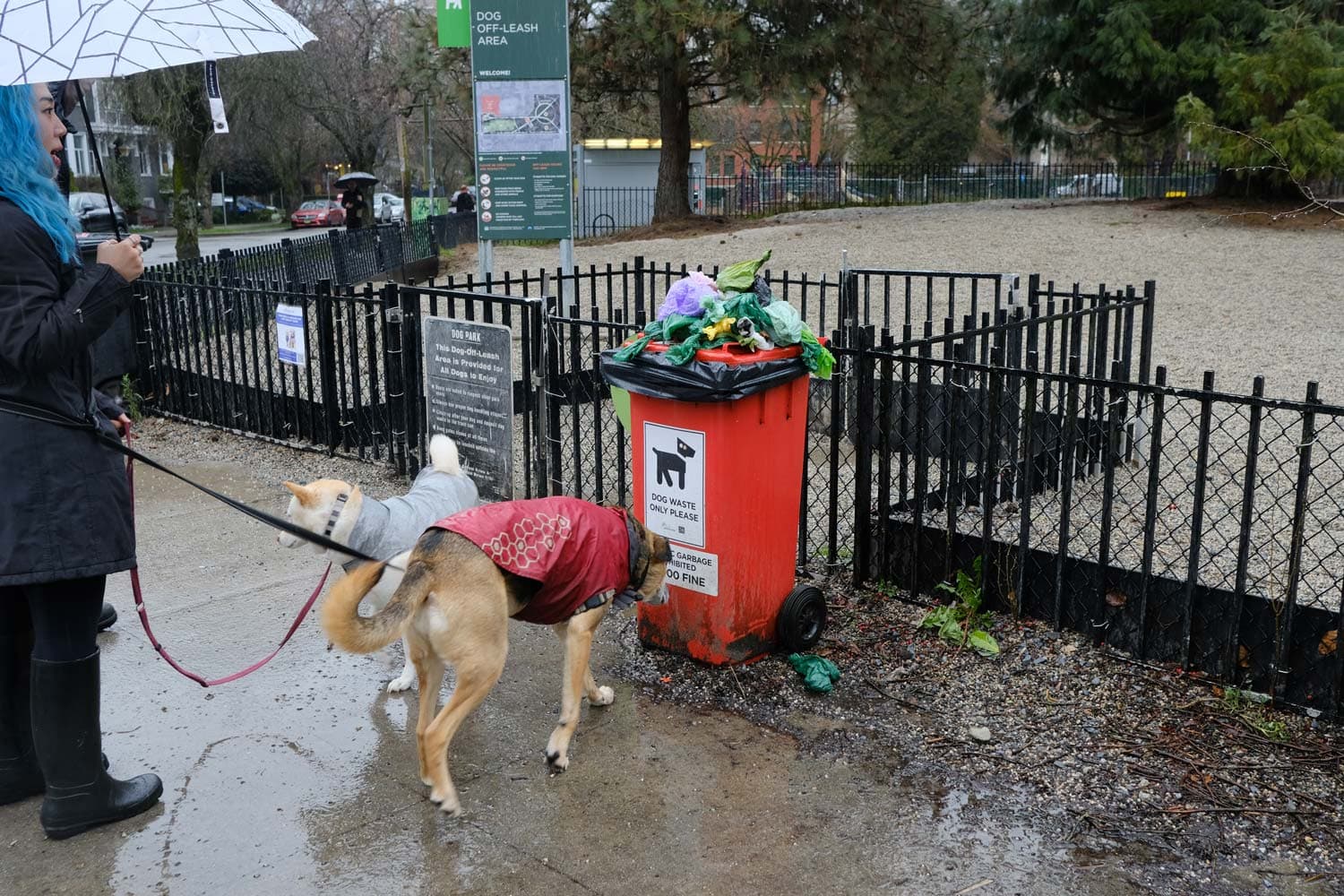
The starting point with dog waste is your local municipality’s recommendations. A 2019 City of Vancouver Engineering Services memorandum examining its dedicated dog-waste disposal regime (namely, the red bins located in dog parks) cites a report saying that the city has between 32,000 and 56,000 dogs. At the US Environmental Protection Agency’s estimated average of ⅓ kg of waste per dog per day, that comes to between approximately 4,000 and 7,000 metric tonnes of poop heading to local landfills every year.

Although few Vancouver dog-owners know it, the City of Vancouver launched a pilot program in 2016 mentioning the option of emptying your dog poop into your toilet, so that it can be handled by the local waste-treatment system. Your empty poop bags can then go into your household trash can.

The reason for flushing is simple, according to Dr. Love-Ese Chile, a bioplastics researcher: when dog feces go to landfill, they don’t properly compost.

“Dog waste often contains a lot of moisture,” Chile explains. “In the non-oxygen environments in many landfills, it will degrade in an anaerobic way to form methane and water.” That methane ends up being released as a greenhouse gas, which adds to climate problems.

Every plastic poop bag has to be opened and emptied out by hand to separate the bag from the waste.

However, confusingly for dog-owners, the signs at most Vancouver dog parks only remind owners that they are responsible for picking up after their dogs, and even the parks participating in the pilot project make no mention of flushing dog waste.

A 2019 memo to Vancouver City Council regarding the City’s red bins for dog waste raised some significant issues, not the least of which is that every plastic poop bag has to be opened and emptied out by hand to separate the bag from the waste. After some processing, the waste goes to the local sewage-treatment plant, and the bags—compostable or not—to the landfill. Perhaps unsurprisingly, a 2023 follow-up memo on this process notes that the City’s call for companies interested in carrying out the poop-bag-emptying process “received no feasible responses…from anybody willing or capable of dealing with this volume of waste.”

Municipalities are still working on creating good systems for handling dog feces, with little consistency from one place to another. As a dog owner, you might do better to check the resources at the Enviro Pet Waste Network. Their aim is to provide easy-to-understand, science-based information for pet owners.

The scoop on the poop

So as a dog owner, what should I be doing? If I flush the dog poop down the toilet, I’m reducing landfill waste as much as possible. If the bags are “compostable,” even better. Aside from microplastics, the “compostable” plastic bags are still greener than plastic bags made entirely from petroleum products.

What I can’t do, though, is mix my dog waste, or my compostable poop bags, with my regular compost pile. Anything containing animal waste should be kept separate from our food gardens, and that includes compost.

One option that the City of Vancouver suggests is that you create a separate compost pit just for dog feces. Detailed instructions can be found at cityfarmer.org—but before you dig a 3-foot-deep hole in the back of your garden plot, take the time to read through dog-owners’ experiences on Reddit or in gardening forums. For everyone who loves their handy dog-waste compost pit, there’s also someone who finds it unwieldy, smelly, or just not effective as a way to compost poop.

Although it’s possible to successfully compost poop, the reality is that it’s not the same as tossing your potato peels in the compost bucket. You’ll need grass cuttings or other plant material—and probably septic-tank starter—to get things working, and your success will depend on the specifics of your soil, climate conditions, and your dog’s breed, size, and diet.

Regardless of how you dispose of the actual dog poop, every dog-owner has to judge for themselves whether a little plastic bag is as green as they want to be. If not, maybe a wooden spoon and an old yogurt container is a better choice.


Without a strong NFB, Canadians will lose sight of who we are

By Barry Rueger
Published: Globe and Mail
June 29, 2024
1148 words

Bill Mason camera helmetWhen I finally bought myself a lovely, red canoe in 1997, it was because I spent my youth, 30 years earlier, watching the many canoeing films by the National Film Board’s legendary Bill Mason.

I recently rewatched Paddle to the Sea, the Mason classic that virtually every child in Canada saw in the 1960s in elementary school. The 1966 film tells the story of a carved, wooden toy canoe containing an “Indian” paddler. The canoe was set free in a river in Northern Ontario, and eventually was carried down through the Great Lakes and out into the Gulf of Saint Lawrence. On its journey, the little canoe was aided by many people – and one dog – who picked it up, rescued it and set it once again on its course to the ocean.

I saw that film during an era when there was no bigger thrill than entering a classroom and seeing a big 16-millimetre film projector and a collapsible white screen. Watching the film again, I noticed some things I hadn’t seen the first time. I was struck by the stereotyped First Nations paddler, but also by the powerful environmental message: The Great Lakes were being polluted by humans, with sewage and industrial waste dumped into the waters. I realized that when I saw the film for the first time, at age 8 or 9, it was the moment I first became an environmentalist, as did a great number of children in my generation.

In an age before the internet, and even cable TV, NFB releases shaped the way generations of Canadian children saw their country, saw the broader world, and saw themselves. Now, it seems as if our country has lost a collective sense of who we are. Sadly, the decline of the NFB has contributed to Canadians losing sight of who we are as a nation and what makes us unique.

As a young person, I learned about the Maritimes through films such as Rising Tide and The Sea Got in Your Blood, saw Saskatchewan grain harvested in Wheat Country, and learned about nickel mining in Sudbury in Miner. Sitting in a classroom in Kelowna, B.C., we experienced dog sleds and igloos in the Northwest Territories (At The Winter Sea Ice Camp), and saw famous singers like Paul Anka and Leonard Cohen – famous Canadian singers in an era when virtually all popular music came from the United States.

Like many of my generation, I allowed NFB films to shape me politically and socially. As I grew older, I explored the experimental and creative reaches of the NFB. The animation of Norman McLaren led me to more political films, such as his 1952 anti-war film Neighbours, and later in my mid-20s, in a church basement in Vancouver, to the controversial and influential anti-porn film Not a Love Story: A Film About Pornography. And as late as 1993, Alanis Obomsawin’s documentary Kanehsatake: 270 Years of Resistance, led me to a strong understanding of First Nations issues, and especially the standoff in Oka.

This was an era when the NFB still had a global reputation. It was well-funded, had production centres all across Canada, and most importantly, was widely known to Canadians and was a source of national pride. It was the very model of a national media organization, a model that filmmakers in other places envied.

In Britain, every person knows or has visited the British Museum. Paris has the Louvre, and Washington has the Smithsonian. Each of these institutions is a cornerstone of how those nations see themselves. Even in these divided times, Americans will look at the Smithsonian and agree: “This is our history.”

Canada lacks a national institution that teaches us who we are. Part of that reflects our relative youth as a single nation, with Newfoundland only joining Canada in 1949, and Nunavut being created 50 years after that. And part of that reflects a population spread out sparsely across our vast, far-flung country, where you can drive for a day or more between populated centres. Those distances mean that the majority of Canadians have never visited the Museum of Civilization or the National Gallery. Instead, for many decades, the National Film Board was the glue that held us together.

In May, The Walrus wrote about staffing cuts at the NFB. According to the NFB’s union, the Canadian Union of Public Employees, 80 out 380 full-time NFB positions were eliminated this year. Regional studios in Edmonton, Halifax and Winnipeg, as well as “interactive studios” in Vancouver and Montreal, have been closed. The union says the recent cuts followed several decades of underfunding. Even though both the NFB brass and the Liberal government claim that the organization is being modernized, or reinvented, the sad truth is that these are insupportable blows and that the film board was already a mere shadow of what it was when I was young. Without production centres in different regions of Canada, and without employees with the time and expertise to create and commission new works, the NFB will cease to be a force that binds our country together.

Despite the boundless reaches of YouTube and TikTok, and despite a Canadian commercial film industry churning out police dramas and Hollywood blockbusters, there is still a desperate need for Canada to have a strong Canadian media production organization that will support the filmmakers and films that Disney or Lionsgate or Netflix won’t touch.

When I was young, the government of Canada was genuinely proud of the National Film Board, and understood that it played a critical role in helping Canadians love and cherish their country. Along with the CBC, the NFB told Canadian stories to Canadians. Even though the CBC is finally seeing some funding to replace the drastic cuts of the 1980s and 90s, the production of popular TV and radio programs is different from the thought-provoking films created at the NFB.

The NFB can still be the place where films are produced that are about us, and where filmmakers of any age can go to learn their craft and produce uniquely Canadian movies and documentaries. The National Film Board can rediscover its role as a cinematic hothouse; a place where non-commercial and experimental forms can thrive, and where the kind of filmmaking happens that will once again influence filmmakers globally.

Just as it was in the past, this is still a time when Canadians – especially young Canadians – need a place where they can see themselves portrayed as genuine Canadians, not as thinly disguised Americans. For that to happen, the government needs to step away from bottom-line concerns, and embrace the value of film as art and film as an instrument for social change. That will require secure and generous long-term funding commitments, and the restoration of production offices in every corner of Canada. The National Film Board is the soul of our country, and it needs to be preserved.

Japanese fusion comes to Nova Scotia’s South Shore

By Barry Rueger
Published: Globe and Mail
June 1, 2024
962 words

Partners and co-owners of Main & Mersey Dining Room and Coffee Bar, Shani Beadle, left, and Andreas Arnmar, right, are photographed at their restaurant in Liverpool, Nova Scotia on December 30, 2023.Meagan Hancock/The Globe and Mail

Andreas Arnmar and Shani Beadle’s road to restaurant ownership was what you could call uphill, right from the concept stage.

Late last year the husband and wife opened the Dining Room at Main & Mersey, an Japanese-fusion restaurant, in Liverpool on Nova Scotia’s South Shore. With a population of 2,500, the town boasts culinary options that lean toward fish and chips and lobster rolls.

Believing locals would appreciate the dishes they were envisioning, such as Oyster Mushroom Tempura or Agedashi Tofu, was a real leap of faith, they say now. And that was just the first challenge.

The couple’s culinary journey started small: with coffee. After moving to Liverpool from the U.K. in 2017 (Beadle is from B.C., while Arnmar was born and raised in Sweden), they opened home-furnishings store Main & Mersey on the town’s Main Street. Beadle’s background in fabric design positioned her well for the endeavour.

While she ran the shop, Arnmar renovated their new home and raised their young daughter. Two years later, they launched a small coffee shop behind the store because, in the words of Arnmar, “there wasn’t any good coffee that we liked around this area.”

Main & Mersey’s menu offerings include, lobster kani salad, left, and salmon misozuke, right.Meagan Hancock/The Globe and Mail

The coffee bar did a lot better than they expected, and so did the bakery they added in 2022, serving up treats such as cinnamon buns, lemon-curd croissants and spinach and feta rolls. Soon, she adds, “I saw how many people we turned away asking for proper food, who didn’t just want fish and chips and chowder. There was a massive gap in the food spectrum, especially when the tourists are in town.”

To fill that gap, Beadle and Arnmar knew they wanted to do something new, namely to go higher end and introduce different flavours to the town’s dining scene. They secured a bigger location just a few feet away from the furniture shop in fall, 2022, and began construction on the space.

A brand-new restaurant kitchen, a welcoming bar and an accessible washroom are all complemented by wood-topped tables, tropical plants and cozy lighting. Much of the painting and tile work was done by Beadle, Arnmar and local volunteers. And they converted the upper floor of the building into apartments, with rent offsetting part of the cost of renovations.

The interior of Main & Mersey Dining Room and Coffee Bar.Meagan Hancock/The Globe and Mail

The couple decided to bring along their pastry chef from the bakery, Aimee Corbet, and hired winemaker and mixologist, Alexandra Beaulieu, as well as a Peruvian-Japanese chef. Their Japanese-fusion menu is integral to their vision, of course, but Arnmar stresses that they’re out to do more than just serve food on plates.

“You can get a great cocktail, you can try a really amazing bottle of wine that you may not have had before. You get food that you may not have tried before, good service‚ and you’re in a beautiful space. It’s just kind of ticking the boxes.”

But inevitably, there were delays. Their grand opening was punted forward two months owing to a shortage of tradespeople in the region and because of government paperwork. In the meantime, they were on the hook for mortgage payments, construction costs and staff salaries.

And then, when opening weekend finally arrived last August, their chef made a sudden departure.

Beadle and Arnmar were faced with a new and almost impossible challenge: How do you run a restaurant without a trained chef? Fortunately, he had already trained the rest of the kitchen to prepare his menu. And Beadle stepped up to take on a job she never expected to fill as a member of the kitchen staff, doing prep for the evening, creating new menu items and training her staff. Meanwhile, Arnmar is up front, welcoming customers and greeting regulars by name.

The restaurant’s grand opening was punted forward two months owing to a shortage of tradespeople in the region.Meagan Hancock/The Globe and Mail

Opening the restaurant stretched the couple’s financial resources to the limit. The first big lifeline came from the FarmWorks Investment Co-operative, a Nova Scotia for-profit co-op that lends funds to food businesses in the province. The funding comes on the condition that the restaurant will buy from provincial producers, and serve Nova Scotia fish, meat and produce.

Beadle is on board. “The idea is we use 50 per cent locally sourced ingredients. That can be wine, that could be produce, that can be meat, that can be mushrooms or whatever. It could be distilled liquor that’s made in the province. Obviously, it’s easier in the summer months than in the winter, but we’re also doing things like pickles and other preserved ingredients. ”

Main & Mersey crowdfunded for the final push before opening day. Beadle posted an appeal on their website and received 85 per cent of the $50,000 they were seeking. “You can’t pull out once you’ve taken people’s money. It’s really impressive, that people in our community will step up like that.”

One of those community members is local Laurie-Anne Brown, who grew up in Liverpool in the 1980s when “it was a thriving paper mill town” with a bustling Main Street full of shops and restaurants.

She hopes new establishments like the Dining Room at Main & Mersey will restore “a thriving Main Street that I once knew.”

Beadle notes that the restaurant had donors from as far away as London and Toronto, but they’re counting on locals, like Brown, and residents of the province from further afield, too. “Build it and hopefully they’ll come. People already get in their car and drive an hour and a bit for our pastries so if the food is good … that’s the plan.”


Bad news

By Barry Rueger
Published: THIS Magazine
January/February, 2024
640 words
Read PDF.

THIS Magazine Jan/Feb 2024

One writer’s desperate howl for a good old-fashioned newspaper

WHEN I WAS 11, WE WENT ON A SCHOOL FIELD TRIP TO THE KELOWNA DAILY COURIER.

I can still remember the linotype machines and drum-shaped metal plates of text and pictures that were loaded into the giant presses to print the paper’s pages.

They gave us a still-hot copy of that day’s paper. I kept it for years, and for decades I‘ve subscribed to the local daily newspaper everywhere I’ve lived. For the past year, that’s been in Liverpool, on the South Shore of Nova Scotia. Since arriving, I’ve realized that we’re in a news desert; a place where Facebook is the beginning and end of local news. That situation grew even worse when the Liberal government enacted Bill C-18, the Online News Act.

Since August, two months after Bill C-18 received royal assent, Facebook has refused to allow users to post Canadian news stories. For Facebook’s owner, Meta, leaving entire towns and regions with no local news whatsoever is a better choice than agreeing to pay the news organizations whose work Facebook users have been reporting.

Liverpool is a place where daily newspapers really don’t exist. Outside of one store in Halifax we can’t buy a Globe and Mail out here, there are no local dailies, and the tiny weeklies are hard to find. Nova Scotia’s largest paper, the Halifax Chronicle Herald, recently stopped printing on  Mondays, and has cut back on its home delivery. Still, every now and then one of the big papers or the CBC would run a story about Liverpool, and someone would post a link to it on a local Facebook page. Now, even that isn’t possible, and in the meantime, the prolonged death of newspapers continues.

In September the Hamilton Spectator shut down its newsroom, and its owner Torstar is ceasing to print dozens of small local papers, moving them online instead. Similar shutdowns are happening in small-town British Columbia.  It seems Southern Ontario and parts of B.C. are about to become news deserts just like southern Nova Scotia. Yes, you can still subscribe to many publications online, but there is a tangible difference between holding a printed paper and reading news on a screen. The printed page establishes the trustworthiness of the news outlet. Having trained reporters and editors and a physical printing press requires an investment that almost always leads to serious journalism. The time and money spent on reporters and editors is one reason why the New York Times and the Globe and Mail are still considered reliable. These publications have a long history as trusted news sources, and still feel a duty to maintain those standards. One may not like their editorial slants, but few seriously question the quality of their reporting.

In Liverpool, on the other hand, we just suffered through nearly two months of a boil-water advisory, and unless you followed the Facebook page for Queens County you wouldn’t have known what was—or wasn’t—happening. Because there are no local reporters, there was also no one asking questions about why an entire town had no drinkable water.

Meta’s actions are not new. For decades, the handful of publishers who control almost all of our news outlets have dramatically reduced reporting staff while shrinking newspaper page counts, and at the same time have closed or merged dozens of small local papers that they’d acquired. What Nova Scotia’s South Shore is experiencing, and what southern Ontario and B.C. are about to experience, is the harsh reality of living in a place where media ceases to be the watchdog that holds governments and corporations accountable, and where there’s no trusted source for people to sort fact from fiction.

Sometime before 2000, 30 years after my field trip, I visited the Conrad Black-era Hamilton Spectator with a friend who worked there. My vivid memory is of hundreds of square meters of blue carpet – half of the giant newsroom – sitting empty of furniture.  Governments turned their heads while Black decimated newsrooms, just as they turn their heads today.

-BARRY RUEGER

Taking care of ourselves without a family doctor has been a challenge


By Barry Rueger
Published: Globe and Mail 
June 24, 2023
1639 words

In need of medical attention
One of the first things that my wife and I did after moving to rural Nova Scotia was to look for  family doctor, but we couldn’t find one accepting patients. Getting care has been a challenge.

My wife Susan and I arrived at our new home in Liverpool, N.S., at the end of 2022. Since then, we’ve discovered one valuable lesson: If you’re trying to learn anything about how things are done here, it will be via word of mouth. This is especially true if you need health care. The Nova Scotia Health Authority and the provincial government have websites, phone lines and pamphlets, but for real answers you need to talk to the people who live here: your neighbours, workmates, people you meet in stores and supermarkets, your librarian, the man who cuts your hair.
Susan and I had both been hammered by a vicious COVID-19 infection the previous September. Over the course of 10 days, we suffered all manner of extreme symptoms, ranging from sweating and coughing to diarrhea and a complete inability to do anything beyond survive. I have never been so sick in my life. Since that time, and continuing after we moved to our new home in Nova Scotia, we’ve suffered endless aches and pains, and continuing fatigue – symptoms that seem to reflect long COVID. We knew that we needed medical attention, and sooner rather than later.
One of the first things we did after unpacking our furniture was to set out to find a family doctor. At store counters and in lineups it didn’t take long to understand that there are only a handful of doctors in Liverpool, and not one of them was accepting new patients. And as far as we could tell driving around or looking online, there is no walk-in clinic here – those “fallback” services seem inexplicably rare in rural Nova Scotia.
Canada’s health care services are in crisis across the nation, but the situation in rural Nova Scotia feels especially severe. Official statistics say that one in 10 people in Nova Scotia have no regular family doctor. The reality is that the government’s “Need a Family Practice Registry” for people without a doctor recently reported that there are more than 142,000 on the waiting list – more like 14 per cent of the population. If you’re in the one big city, Halifax, you may have some choice, but the rest of Nova Scotia is rural, and doctors are scarce.
People in my area on the registry’s list can eventually sign-up with a “real doctor” at the Collaborative Family Practice at Liverpool’s Queens General Hospital. Until then, though, you’ll be encouraged to visit the emergency department during the few hours a day when they’re open. For instance, in a recent week in May there were four days when the emergency department shut down at 1:30 p.m. until the following morning at 8 a.m.
In the meantime, those 142,000-plus people without a family doctor are being directed to Maple, an online medical practice that operates across Canada. The publicly funded side of Maple in Nova Scotia – there is also a for-profit, pay-for-service side available – is also short of physicians, and many patients are directed to nurse practitioners.
Even if you reach a qualified doctor, there is no route available to you to return to the same doctor for a follow-up or to discuss the results of tests – you are given the first doctor or nurse practitioner available. If needed, it’s possible that you’ll be referred for an in-person consultation, but that usually doesn’t happen, and I can’t help wonder what’s being missed when knee problems or internal aches and pains are being diagnosed by a different practitioner every time, and over an online video instead of in person.
And that is the real problem. As willing and knowledgeable as the doctors and nurse practitioners are on Maple, it’s still a video call on your laptop. You can hold your phone or iPad up to the area where you’re hurting, but sometimes you really do need a medical professional to examine you in-person, touching, prodding and assessing where your problem lies.
The shift from in-person to online medical evaluations makes a profound difference. We’re feeling the lack of having a regular doctor who knows us and our medical histories. Instead of the familiar routine of visiting a doctor who already knows you, briefly checks your file as a memory refresher, and then begins a consultation and diagnosis based on that knowledge, we find ourselves sitting in our kitchen with printouts and pill bottles at the ready. Every consultation involves using most of the brief time allotted to update a new physician. The onus is now on the patient, not the doctor, to maintain, organize and communicate a full medical history.
There’s also the very real worry about what would happen if we need emergency medical care. This week, the mayor of Middleton told Nova Scotians about a frightening incident. In a letter to Premier Tim Houston, Sylvester Atkinson described how on the evening of June 15, the local volunteer fire department was called to the Soldiers Memorial Hospital in Middleton. The local fire department was called because there were no doctors in the hospital, and no doctor on-call, and a patient was in cardiac arrest. The firefighters did what they could, but the patient died. A doctor did drive down from Kentville, a half-hour away, and declared the patient dead. For small-town residents like me, the story is absolutely terrifying.
Fortunately, we haven’t needed any emergency treatments since we moved here, although we have found ourselves at the local hospital for other medical services. Even when the hospital’s emergency room isn’t admitting patients, the hospital lab and X-ray departments are still open, and it’s possible to be in and out for X-rays or blood tests in a few minutes. And even if it’s near impossible to see a doctor some days, we appreciate that the rest of the medical workers there will take the time to explain what they’re doing, why they’re doing it and to gossip about local affairs.
That is honestly the one positive side to Nova Scotia’s woeful medical system: The local health care team of nurses and lab technicians are relaxed and friendly, and likely someone you’ll run into at the library or supermarket. After decades of brusque treatment in big cities such as Vancouver and Toronto, it’s nice to deal with real people who seem to genuinely care about your welfare.
Nova Scotia’s current budget claims to be ramping up health care spending, but the two headline areas in the government releases are retention bonuses for nurses (to the tune of $110-million), plus an additional $50-million to address continued surgical backlogs. Still, many people believe that not enough attention is being paid to the challenge faced by many Canadian health care systems: a significant lack of doctors, especially family doctors. As convenient as it is to access nurse practitioners and pharmacists for day-to-day health needs, the most important member of your health care team is still a consistent family doctor.
I was raised at a time when every family had a doctor – someone who cared for parents and children through all life stages, tracking their history from month to month and from year to year. These physicians lived in your community and were a constant in your life. It was understood that medical care was not just about emergencies, it was about keeping patients healthy on a continuing basis. It was about a long-term personal relationship with a physician who you knew and trusted.
Today, in rural Nova Scotia, that sort of relationship is harder to find. The older doctors are retiring, and news reports tell us that new, younger doctors don’t want to take on a small-town family practice.
I can’t help but think that decades of “restraint” budgets, and the losses to health care funding that resulted, have to be responsible for this change. Young doctors look at practices in small-town Nova Scotia and see nothing but overwork and underpay, long backlogs on routine surgeries and referrals, and medical treatments such as physiotherapy or prescriptions that aren’t covered in one of the poorest provinces in Canada. Is it any wonder they shy away from family medicine?
Ultimately this all speaks to priorities. Nova Scotia brags about an increase of 21 per cent in health care spending over two years, but every time I drive from Liverpool to Halifax to see a specialist or a relative in hospital, I can’t help but notice the tremendous amount of highway construction that is happening. To my eye, neither the population of Nova Scotia, nor the traffic volumes, merit the hundreds of millions of dollars being spent to upgrade all these roads to four-lane divided highways.
It feels as if Canada’s second-smallest province – only Prince Edward Island is smaller – chooses highways over health care. That, I think, is the core of the problem we face in Nova Scotia: Health care is seen as an expense, while highways are an “investment.” We’re faced with months of waiting for surgeries, and we sometimes get questionable treatment options over video chat – but at least the drive to Peggy’s Cove is wonderful.
After many months reflecting on the sad reality that we can’t have a family doctor, we had come to accept the unfortunate situation. Last week though, with no warning, we received a phone call from Queens General Hospital’s family practice. I don’t know how we reached the top of the list, but we now have a family doctor once again. Ours was trained in Khartoum, and several weeks ago he’d left a position in Birmingham, England, for his new job in Liverpool, N.S. He tells us he likes the small town that is now his home. We don’t yet know what chain of events led us to having our new doctor, but he seems good, and we’re very relieved. I hope the many other thousands of Nova Scotians on the family-practice waiting list also receive good news soon.

Nova Scotia’s forest fires make me wonder if our dreams of a green, rural life were misguided

By Barry Rueger
Published: Globe and Mail 
June 3, 2023
815 words

We’ve made our home at the point of Western Head, near Liverpool, N.S. On Tuesday, I was awakened at 4:30 a.m. when my phone shrieked with a warning from the government of Nova Scotia telling me not to light a campfire. By the time the sun rose around 6:30, there was a curtain of thick grey smoke, and I could taste it on the back of my throat. We already knew about the forest fires burning out of control in our province, so the real question was: Where was the smoke coming from, and how close was the fire?

We live right between the two major blazes. The Tantallon fire is about 30 kilometres from the Halifax Citadel. At the time I write this, on Thursday, we’re told that it has consumed about 837 hectares, and is possibly becoming under control. The other one is the Barrington Lake fire in Shelburne County. It had been the fire nearest to our children and grandchildren, burning more than 17,000 hectares. Then late Wednesday night we heard that another wildfire had broken out perhaps three or four kilometres from their house. Fortunately they had already packed up and left to stay with friends in New Brunswick – the smoke was just too much for them.

After waking on Tuesday, the morning was spent on the internet, and looking at whatever media we could find to try and get an up-to-date picture of these blazes. My frustration grew as I realized that anyone who could be updating me had disappeared. Government, media, even the pundits on Reddit and Facebook had all booked off at 8 o’clock the previous night. If the fire changed direction or speed, or if you just needed to know what was happening now, not 12 hours ago, you would need to wait.

Western Head is part of a point of land just below Liverpool. It’s sparsely populated, and has one road that loops along the shore of the Atlantic Ocean that surrounds it. That morning, while we waited for any information about the fires, the isolation that had been so appealing to us took on a different tone.

Ever since moving here people have told us that the summers have become hotter, and the weather dryer. Now I look at the forest and bush that surrounds us and find myself thinking about how fast it could all go up in flames.

And I’m thinking that if the fires are this bad in late May, what on Earth will arrive in July and August?

At one point on Twitter – apparently the best source for up-to-the-minute fire news – I read that Halifax Fire deputy chief David Meldrum had said: “Without a doubt … climate change is contributing to volatility.”

That statement is, in many ways, the one that frightens me most. Right now there are thousands of households evacuated, and multiple fires out of control. If you live anywhere in Nova Scotia you’re wondering if your town or county will be next. The one thing that’s agreed on is that this is not normal for Nova Scotia.

We moved here, bought our home here, to escape the pressures of the big city. A very large part of that decision was a chance to be more self-sufficient: to grow our own food, care for our own land, and rely less on governments and corporations for day to day needs. And yes, doing all of this in an environmentally friendly way is important to us.

Now I’m wondering if our dreams of a rural, green life were misguided – if we were fooling ourselves into thinking that we could remove ourselves from the fast-paced, plastic-wrapped scurry of city life.

The challenge for us now is to try and understand if the changes coming at us because of climate change will overwhelm whatever efforts we can muster to adapt to them. Yes, we can adapt our home, and the ways that we eat and grow our food. We can remove the old oil-burning furnace, and add solar panels. But is that enough to counter global warming, rising sea waters and forest fires?

So far, the fires have stayed away from us, and have even changed direction, but Nova Scotia is heading into a summer of hot and dry weather. Instead of relaxing in our yard, building a compost bin and cutting grass, I’m spending my day on the internet and watching press conferences to try and guess whether we should be loading up the car and heading somewhere else to be safe.

And, of course, I’m asking about the future of our grandchildren.

That, more than anything, terrifies me. So far they’ve survived this year’s fires OK, but what about the next ones, and the ones in the years that follow? Will it become normal for them to wake up to a hazy sky, the taste of smoke lingering on their tongues?