Understanding the Different Types and Causes of Seizures

By Barry Rueger
Published: Next Avenue
Aoril 9, 2025
1313 words
Read on-line.

Next Avenue Logo

One sunny day in mid-October I realized that I was in the hospital. I didn’t know why, and I didn’t know how long I had been there, but I was definitely in the emergency ward at Vancouver General Hospital.

By the end of the day I had learned that my wife, Susan, had found me on the dining room floor in my dressing gown, that she had called the paramedics and that through the examinations and the ambulance journey, my eyes had been open and I was answering questions.

A week later, my new neurologist, Oscar Benavente, M.D., told me that I had probably suffered a seizure. The “probably” was because the event had happened days earlier, and he hadn’t been there to see it.

According to the Cleveland Clinic, there’s a one in 10 chance you will have a seizure at some point in your life. The likelihood increases depending on underlying medical conditions, a family history of seizures or if you are over 50. Children can also experience seizures.

A seizure is, at its simplest, a surge of electrical activity in your brain that causes affected brain cells to quick-fire random signals to other surrounding cells. Your seizure can be a one-off event, or if it is caused by epilepsy, may be one in a continuing series. Your doctor might be able to say why your seizure happened, or it may remain a mystery. And those electrical signals can cause all kinds of symptoms.

Types of Seizures

In the broadest of terms, you’ll want to know if you are suffering from epileptic seizures, meaning you’re prone to having repetitive attacks, or if your seizure is likely an isolated episode. How your doctor will determine this is through observation over a long period of time. In my case this meant that for the following six months I was prohibited from driving, and was monitored for further seizures.

Seizures are first categorized by type of onset. Your doctor will ask whether your seizure began on one side of your brain (a focal-onset seizure) or on both sides (a generalized-onset seizure). If you can’t tell, it may initially be classed as an unknown-onset seizure. The neurologist will try to answer this and other questions by booking a variety of tests including a CT brain scan (computed tomography, using X-rays to scan the brain), an MRI (magnetic resonance imaging, using magnets), and possibly an EEG (electroencephalogram), a test that measures electrical activity in the brain.

Those three broad categorizations are useful, but seizures fall into dozens of different categories and combinations depending on your specific symptoms — and whether anyone was on hand to note what was happening. Most seizures last only a minute or two, so there’s every chance that it will be over before anyone else could notice how you behaved, or what parts of your body were moving in which fashion.

No Longer Called Grand-Mal

Most people associate a seizure with (what used to be called ) a grand-mal seizure, where an unconscious person’s limbs shake and jerk. These seizures — now termed “tonic-clonic seizures” —are just one of a variety of generalized-onset motor seizures. These seizures include both clonic behaviors — rhythmic jerking — and tonic stiffening, where parts of your body become rigid. Generalized-onset seizures can also include spasms, or loss of muscle tone or combinations of behaviors.

There are also generalized-onset non-motor seizures, (formerly petit-mal seizures) which still originate on both sides of the brain, but include absence seizures, where a patient “blanks out” for a few seconds but without any lasting symptoms.

Focal-onset seizures begin in only one area of the brain and can be categorized by the patient’s level of awareness. If awareness is impaired during any part of the seizure, the seizure is classified as a focal impaired-awareness seizure. As with generalized-onset seizures, jerking and stiffening of parts of the body are common events although often only one limb or one side of the body will be involved. It is common for an initially focal seizure to spread to other parts of the brain, creating a focal to bilateral tonic-clonic seizure.

If clinicians are unsure about a seizure, they may choose to describe it as an unknown-onset seizure. After further testing and scans they may be able to reclassify it as either general- or focal-onset seizure. This is important for choosing the correct approach to treatment.

Possible Causes

Just as there is a long list of seizure types, the possible causes of a seizure can vary widely, and it’s not always possible to be certain of the cause. Merck & Company’s MSD Manual lists risk factors such as head trauma, neurological disorders, family history, alcohol or drug use (or withdrawal) or not following prescribed anti-seizure drug schedules. More factors can include a high fever or heat stroke; brain infections from malaria, HIV, rabies or a variety of other bacterial or viral conditions. High or low levels of glucose or sodium can be a cause, as can kidney or liver failure.

Various cardiac problems may cause inadequate oxygen supply to the brain, as can near-drowning or carbon monoxide poisoning. Damages to the structure of the brain, such as strokes or tumors, can trigger a seizure, as can fluid accumulation, and poisoning from lead or strychnine also will cause a seizure.

In other words, just as a doctor may not ever determine exactly what type of seizure a person had, the patient also may never know what caused it.
Is Your Dog’s Poop Bag Really Eco-friendly?

By Barry Rueger
Published: Asparagus Magazine
April 4, 2025
1483 words
Read on-line.

The story of compostable dog-poop bags is complicated—as is the story of dog-poop disposal in general.

According to some accounts, the idea of a small bag that could be used to pick up dog poop dates back to 1986, when Californian businessman Chris Crosson created the first dog-poop bag. Another claim dates it to the early 20th century, when Teddy Roosevelt got tired of cleaning up his dog’s droppings and instead would carry a pocket-sized bag for that purpose.

Regardless of who had the idea first, over the past 100 years it has been almost universally accepted that every dog owner should collect their pet’s waste. More controversial is the question of how that waste should be disposed of.

Dog waste carries diseases, so you want to keep it away from food, gardens, and waterways. Disease experts such as the US Centers for Disease Control and Prevention say that dog feces can spread pathogens ranging from Campylobacter, Giardia, and E. coli, to hookworm and roundworm.

Even setting aside the disease problems, piles of dog poop on sidewalks and lawns are unpleasant, smell bad, and ick up your shoes when, inevitably, you step in them. Grabbing poop with a little plastic bag and tying the top shut seems like a simple solution—unless you’re trying to do it sustainably.
What’s your bag?

What’s your bag?

If you walk into any pet store, you’ll see shelves full of poop bags of different brands and colours—most of them manufactured in China, but some in the US or Canada. Many of them will claim to be “compostable.” The problem is how you define that term.

The group that certifies most products as “compostable” in North America is the Biodegradable Products Institute (BPI). They have tested thousands of products and allow manufacturers to use the BPI certification mark to demonstrate that what they’re selling can, in fact, be composted.

The problem for Canadian dog owners is that Canadian and American rules are different. BPI explained to Asparagus in an email that “Pet Waste Bags aren’t currently accepted by most commercial composters in the United States, so BPI Certification for Pet Waste Bags is limited to Canada, where those types of products are commonly accepted by curbside composting programs.” This means that dozens of brands of poop bags that wouldn’t be approved in the US can be labelled as “compostable” in Canada.

Generally speaking, “compostable” plastics such as poop bags are made mainly of polybutylene adipate terephthalate, or PBAT. This polymer is synthesized from fossil fuels, though research suggests it could be derived from biomass in future. It is combined with plastic-alternative materials such as polylactic acid (PLA)—typically made from fermented plant starch obtained from plants like corn, cassava, sugarcane, or potato—to toughen them up while retaining the promised biodegradability.

The issue is, although PLA is considered to be compostable in precisely controlled industrial conditions, it is not compostable in home composts or landfills. One 2012 study suggests that in a landfill setting, it could take 100-plus years for PLA to complete the chemical process needed to just start biodegrading.

That problem seems to exist for most “compostable” plastics. Although they will usually degrade, sometimes in only a few years, the degradation relies on the plastic being disposed of under just the right conditions. The moisture of the compost environment, the temperature, and even the size of chopped-up particles that the bags have been reduced to all affect the composting process.

There are currently no international standards or guidelines for home-composting conditions, but companies from many countries—including some from Canada—use the Austrian “OK compost HOME” certification, which defines polymers as home-compostable if at least 90% are degraded within 12 months at ambient temperatures of 20–30°C.

Another issue is the release of microplastics from “compostable” plastics. While research is still being carried out on this, one 2021 study of PBAT in an aquatic environment found that PBAT released “a much larger quantity of plastic fragments/particles” than did LDPE, the plastic commonly used for food wraps, grocery bags, and industrial packaging.

All of this may explain why, as of 2023, BC has stopped allowing items labelled “compostable plastic” to be put in any compost. The Government of BC webpage on the issue states, “[T]hese plastics are regularly removed from composting and recycling facilities and are sent to landfills.”

Disposal dilemma

So you’ve picked up poop in a bag that is more-or-less compostable. Now what do you do with it? As is often the case with waste disposal, the challenge is that you’re trying to dispose of two different materials that need different handling. And you’re trying to do that within the specific rules and procedures put in place by your local municipality.

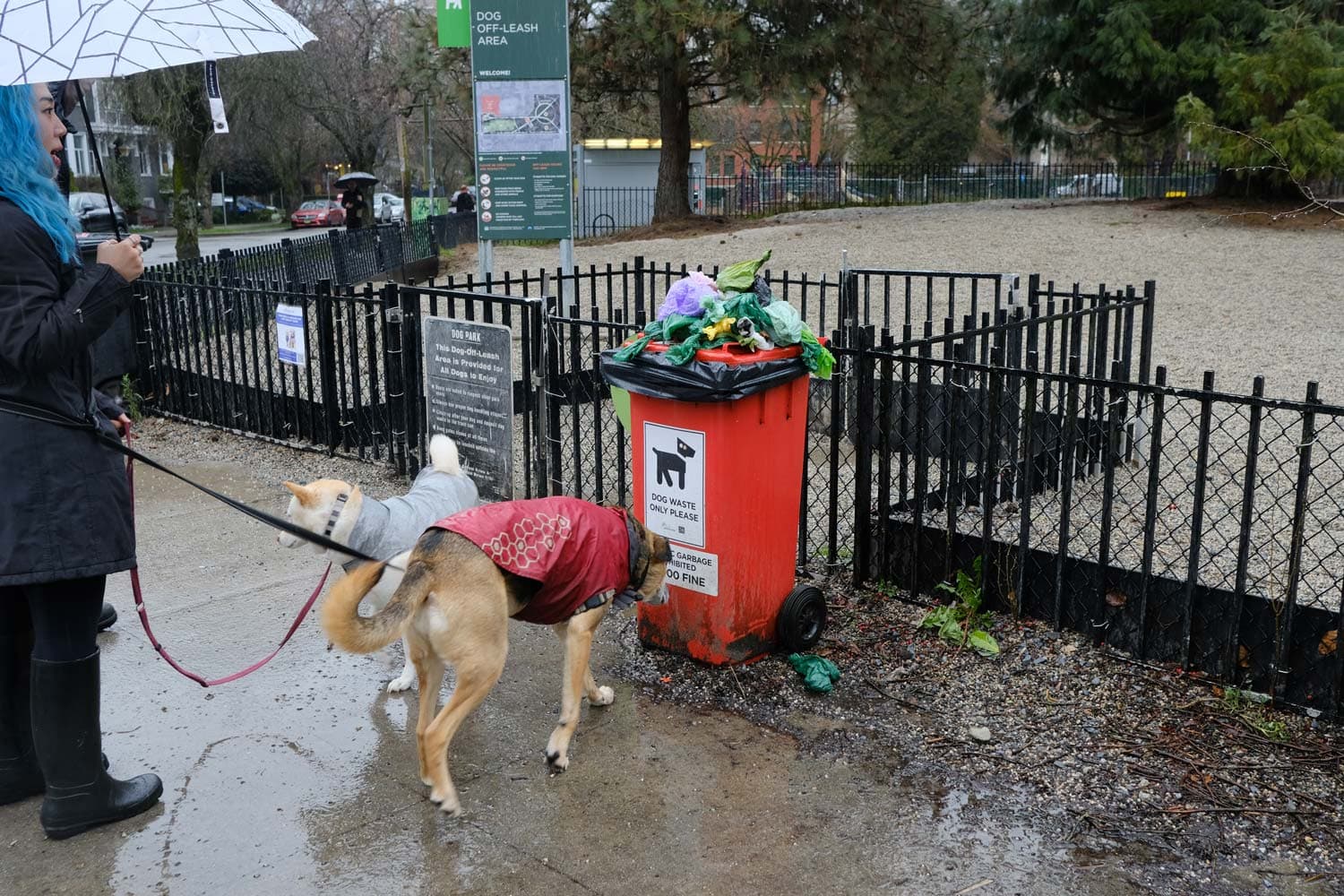
The starting point with dog waste is your local municipality’s recommendations. A 2019 City of Vancouver Engineering Services memorandum examining its dedicated dog-waste disposal regime (namely, the red bins located in dog parks) cites a report saying that the city has between 32,000 and 56,000 dogs. At the US Environmental Protection Agency’s estimated average of ⅓ kg of waste per dog per day, that comes to between approximately 4,000 and 7,000 metric tonnes of poop heading to local landfills every year.

Although few Vancouver dog-owners know it, the City of Vancouver launched a pilot program in 2016 mentioning the option of emptying your dog poop into your toilet, so that it can be handled by the local waste-treatment system. Your empty poop bags can then go into your household trash can.

The reason for flushing is simple, according to Dr. Love-Ese Chile, a bioplastics researcher: when dog feces go to landfill, they don’t properly compost.

“Dog waste often contains a lot of moisture,” Chile explains. “In the non-oxygen environments in many landfills, it will degrade in an anaerobic way to form methane and water.” That methane ends up being released as a greenhouse gas, which adds to climate problems.

Every plastic poop bag has to be opened and emptied out by hand to separate the bag from the waste.

However, confusingly for dog-owners, the signs at most Vancouver dog parks only remind owners that they are responsible for picking up after their dogs, and even the parks participating in the pilot project make no mention of flushing dog waste.

A 2019 memo to Vancouver City Council regarding the City’s red bins for dog waste raised some significant issues, not the least of which is that every plastic poop bag has to be opened and emptied out by hand to separate the bag from the waste. After some processing, the waste goes to the local sewage-treatment plant, and the bags—compostable or not—to the landfill. Perhaps unsurprisingly, a 2023 follow-up memo on this process notes that the City’s call for companies interested in carrying out the poop-bag-emptying process “received no feasible responses…from anybody willing or capable of dealing with this volume of waste.”

Municipalities are still working on creating good systems for handling dog feces, with little consistency from one place to another. As a dog owner, you might do better to check the resources at the Enviro Pet Waste Network. Their aim is to provide easy-to-understand, science-based information for pet owners.

The scoop on the poop

So as a dog owner, what should I be doing? If I flush the dog poop down the toilet, I’m reducing landfill waste as much as possible. If the bags are “compostable,” even better. Aside from microplastics, the “compostable” plastic bags are still greener than plastic bags made entirely from petroleum products.

What I can’t do, though, is mix my dog waste, or my compostable poop bags, with my regular compost pile. Anything containing animal waste should be kept separate from our food gardens, and that includes compost.

One option that the City of Vancouver suggests is that you create a separate compost pit just for dog feces. Detailed instructions can be found at cityfarmer.org—but before you dig a 3-foot-deep hole in the back of your garden plot, take the time to read through dog-owners’ experiences on Reddit or in gardening forums. For everyone who loves their handy dog-waste compost pit, there’s also someone who finds it unwieldy, smelly, or just not effective as a way to compost poop.

Although it’s possible to successfully compost poop, the reality is that it’s not the same as tossing your potato peels in the compost bucket. You’ll need grass cuttings or other plant material—and probably septic-tank starter—to get things working, and your success will depend on the specifics of your soil, climate conditions, and your dog’s breed, size, and diet.

Regardless of how you dispose of the actual dog poop, every dog-owner has to judge for themselves whether a little plastic bag is as green as they want to be. If not, maybe a wooden spoon and an old yogurt container is a better choice.